
Text: Paola Malavassi
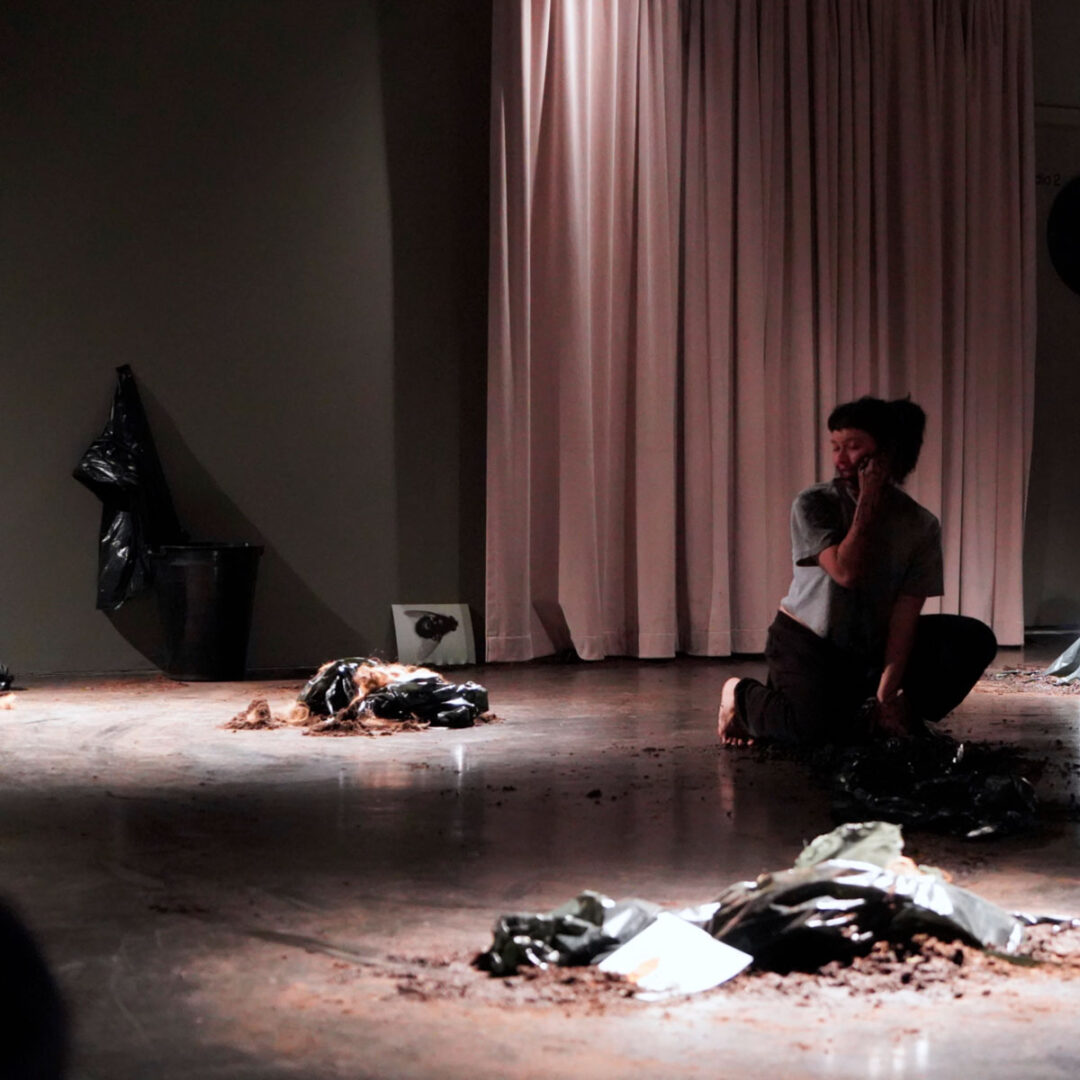
The performance begins in the nose. Before anything is said or done in Larva, viewers notice the humid scent of earth as they enter the performance space at Radialsystem. Thick and unmistakable, it replaces the neutrality of the stage with the presence of soil. And so, Colombian artist María Gabriela Rubio Hernández’s performance begins not visually but somatically, experienced by the audience from within as they take in the muddy dampness, organic and alive. The scent, both familiar and unsettling, immediately effects a shift in perception.
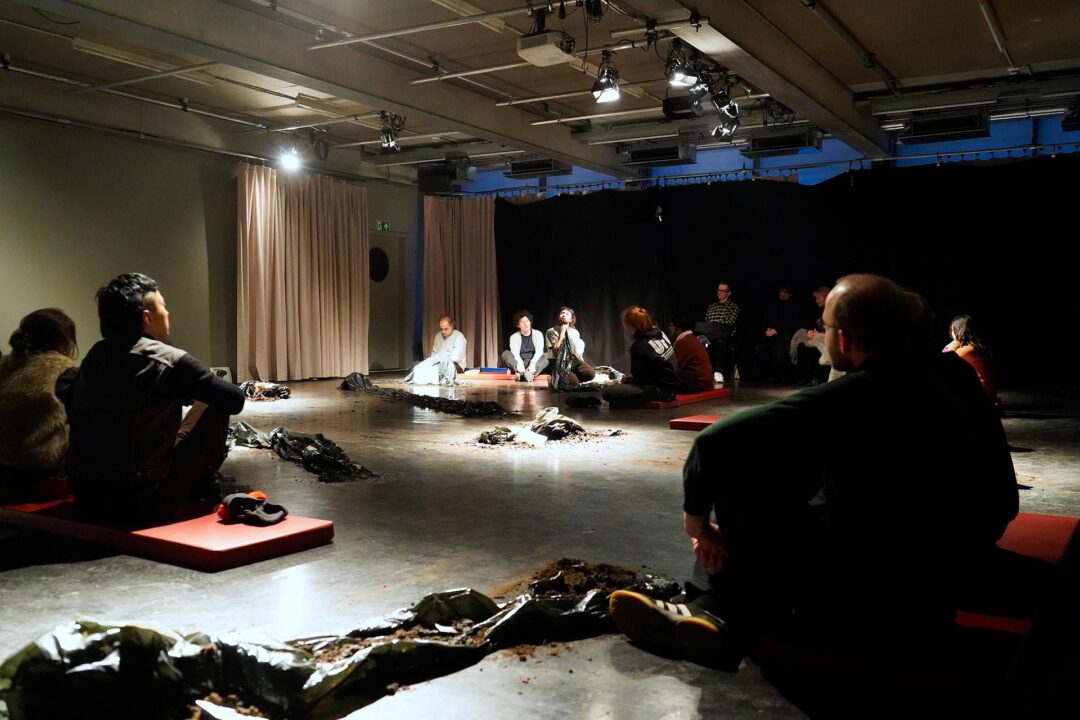
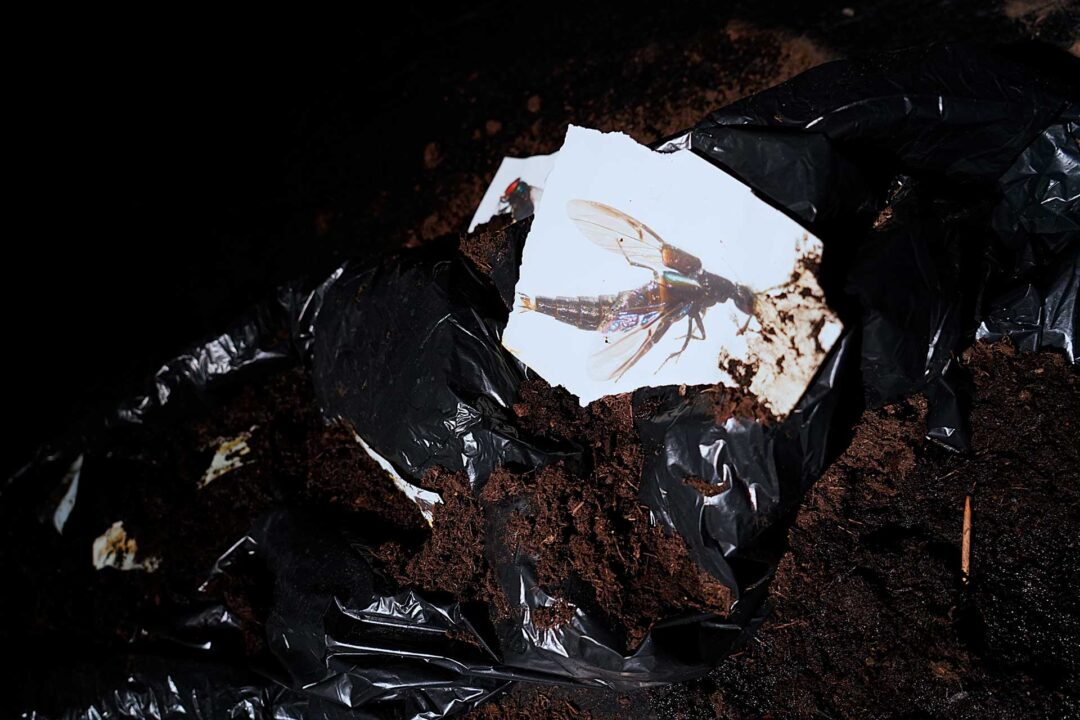
The space is dimly lit. Piles of earth are scattered across the floor. Viewers eventually sit on soft pads placed on the ground, bringing their bodies physically closer to the soil that delineates the space. Photographs of insects are placed around the stage, strands of hair appear among the materials, and large black plastic bags recall body bags. Meanwhile, sounds in the room evoke the movements of unseen creatures: insects burrowing into the earth or buzzing about in the air; perhaps, birds singing; the sound of water, thick and dense like mud. At one point, the artist tells the audience that the first fly typically arrives only nine minutes after a dead body begins to decompose, a sordid reminder of how quickly nature sets to work.
Walking slowly across the space, the artist stops to remove her shoes, socks, and glasses as her voice begins to emerge: “There are several distinct relationships between an insect, insecto, and a decomposing body, a corps—ssse. There are—rrr…” The photographs, taken under a microscope by Colombian artist Ari Fuquen in Bogotá, capture genres of insects that feed on decaying flesh. In forensic investigations, as Rubio Hernández tells the audience, these insects can carry crucial information about the time of death, especially when bodies are discovered far from where they were killed and other traces have disappeared. The images introduce another layer to the performance: nature not only consumes the body but also records its passing.
The voice enters in fragments. Rubio Hernández vocalizes sounds and words in Spanish and English, stumbling over syllables, repeating consonants and sounds until they dissolve into something closer to noise than language. Insecto, she says. Iiin-secto, sss, scts, tsss… The words stretch and contract, the voice is sometimes sharp, sometimes whispering. At moments it mimics buzzing insects; at others, it evokes machines, weapons, or destruction. “¿De dónde crees que han sacado las armas?” (“Where do you think they got the weapons from?”) she asks again and again. Later: “¿De quién es la culpa? Todos deberíamos ser culpables.” (“Who is to blame? We should all be blamed.”)
The questions remain unresolved. They linger in the room, carried by vibrations of voice and movement. Some experiences resist articulation. In Larva, emotion and gesture communicate what language cannot: feeding and destruction, survival and aggression, fragility and violence existing simultaneously.
Violence in Colombia has claimed approximately 800,000 lives and disappearances over decades of armed conflict. Rubio Hernández evokes the arbitrariness of such violence through a ritual in which audience members are assigned numbers. From time to time she returns to one of them, saying the number aloud and placing a handful of soil in their hands. The chosen spectators hold the earth until the performance ends. The gesture is simple yet unsettling. The soil becomes a tangible reminder of absence—of bodies lost, hidden, or returned to the ground.
Developed within the mentorship framework of Forecast in collaboration with Elaine Mitchener, Larva merges spoken word, electroacoustic sound, and raw organic materials.
Rather than illustrating individual histories of violence directly, the performance renders them through experience. The audience is not asked to witness violence but to inhabit the landscape left in its wake. The sonic environment is similarly dense and layered. Text fragments from poems by María Mercedes Carranza (El Canto de las Moscas, 1997) and Álvaro Cepeda Samudio (La Casa Grande, 1962) appear and dissolve. Words repeat, break apart, and return as sonic gestures rather than stable meaning. Language behaves like matter—emerging, eroding, and sinking back into silence.
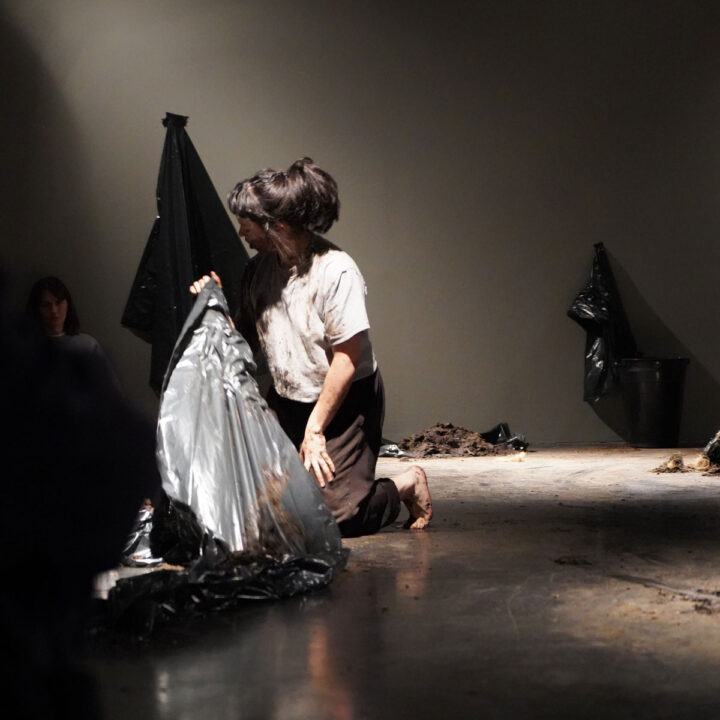
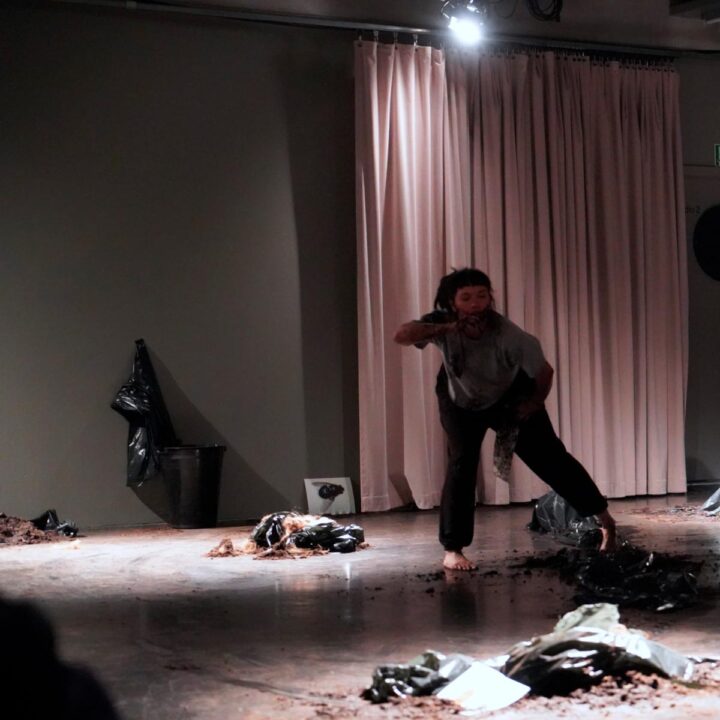
The work’s title evokes a process of transformation. A larva exists in a suspended state of becoming, on the verge of undergoing metamorphosis. This idea resonates with the work’s shifting structure, somewhere between installation, performance, and ritual, while materials change meaning depending on how they are encountered. Sound dissolves into noise, language oscillates between articulation and abstraction, and movement evokes both human and animal instincts.
The mentorship process helped shape the work’s immediacy. Mitchener’s open call, bearing the prompt “Don’t Overthink It,” encouraged a direct and intuitive approach to creation. This ethos is palpable in Rubio Hernández’s piece, whose power lies in its openness. Larva is raw and urgent, embracing rough textures and spontaneous gestures rather than polished spectacle. Ultimately, Larva confronts the audience with the material reality of the earth and the fragile presence of the human body within it. The scent of mud, the weight of sound, and the tactile memory of soil mark the experience. Viewers are invited not simply to observe but to inhabit a space where body, environment, and memory merge.
The experience lingers long after the performance ends. These traces—olfactory, sonic, and tactile—remind us of processes of transformation and disappearance, evoked without re-victimization. In a world where arbitrary violence continues to destroy human life and natural environments, the performance confronts us with this reality with unsettling clarity.