
Text: Jesi Khadivi
Photos: Dorothea Tuch

At first, Kihako Narisawa seems to blend into the crowd. Only three megaphones mounted on a tripod and a projection screen hint at a performance scenario. Removed from the live setting, experiencing Narisawa’s movements through my computer screen, I watch her slowly weave through the foyer of the Gropius Bau, smoothing her hair and checking the sound equipment amid the din of passersby—gestures and sounds that anyone familiar with live performance or presentation would associate with those charged, introspective moments spent waiting to engage an audience. I initially thought the camera had started too early. And so, I waited for a clear beginning that never came.
The flow of people heading down the staircase thinned to a trickle and the echoes of conversation began to dissipate, yet Narisawa continued: smoothing her hair, sitting down on the marble staircase to tie her shoes, tucking in her shirt, checking the waistband of her pants, tying her hair into a high ponytail. Her grand entrance never came. Instead, we see a gradual, almost imperceptible accumulation of gestures: stretching, leg lifts, circling the heels, wrists, and ankles—motions that hover between the performance and the warm-up, the rehearsal and the act itself. At intervals, the live scene is expanded by a projected image of Narisawa seated on a stark stage, her back turned to the viewer, facing a microphone. The body appears twice—once embedded in the flow of the foyer, once removed, flattened, and withheld—introducing a split between presence and representation. Kihako Narisawa’s performance layer(s), developed for the 10th edition of Forecast in conversation with mentor Hussein Chalayan, delves into the performance of identity through precisely this kind of suspension.
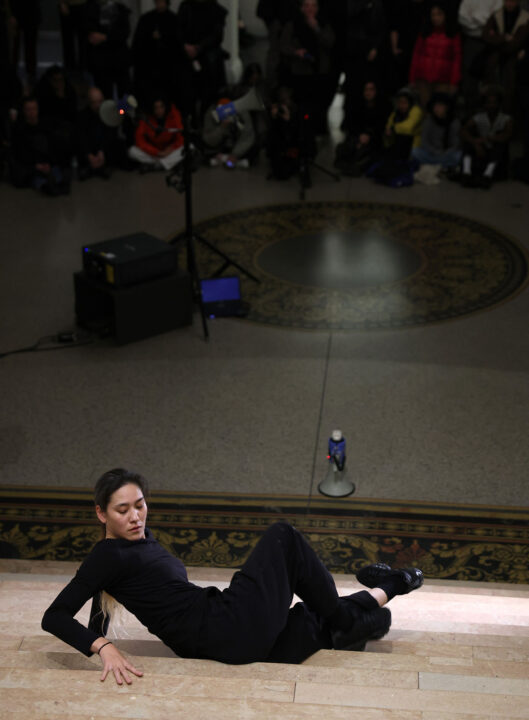
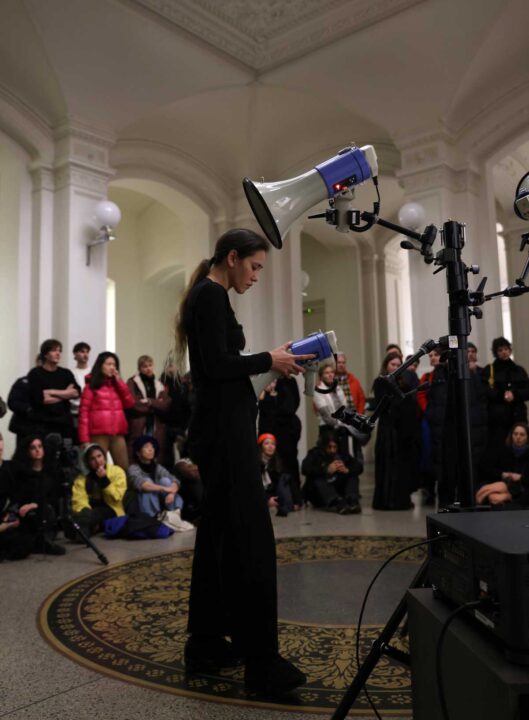
Time in layer(s) is lived, extended, elastic. The ping of a notification-like tone, the changing projection of words—“Have you ever, would you, are we, are you, then…”—creates a sense of continuity punctuated by micro-events. These small sonic and textual markers punctuate the temporal field without resolving it. Suspense is structured not by narrative climax but by duration, repetition, and withheld expectation. As Chalayan has observed, Narisawa tests our thresholds of patience and boredom while building anticipation through subtle human behaviors, framing absent actions and gestures around objects typically linked to communication or daily ritual. The frustration this evokes becomes a tool: a means of making the audience conscious of its own assumptions about what a performing body should provide, and for whom.
While Narisawa has cited Oliviero Toscani’s campaigns for Benetton as a point of reference, layer(s) operates through a markedly different visual and temporal logic. Where Toscani’s images rely on immediacy and legibility, confronting viewers with stark representations of diversity, Narisawa’s performance unfolds through delay, repetition, and ambiguity, resisting direct representation in favor of a more diffuse and experiential engagement with identity. Rather than drawing upon a lexicon of familiar gestures or the legible markers of group belonging, she engages identity as somatic experience: something that accumulates in the body through lived encounter.
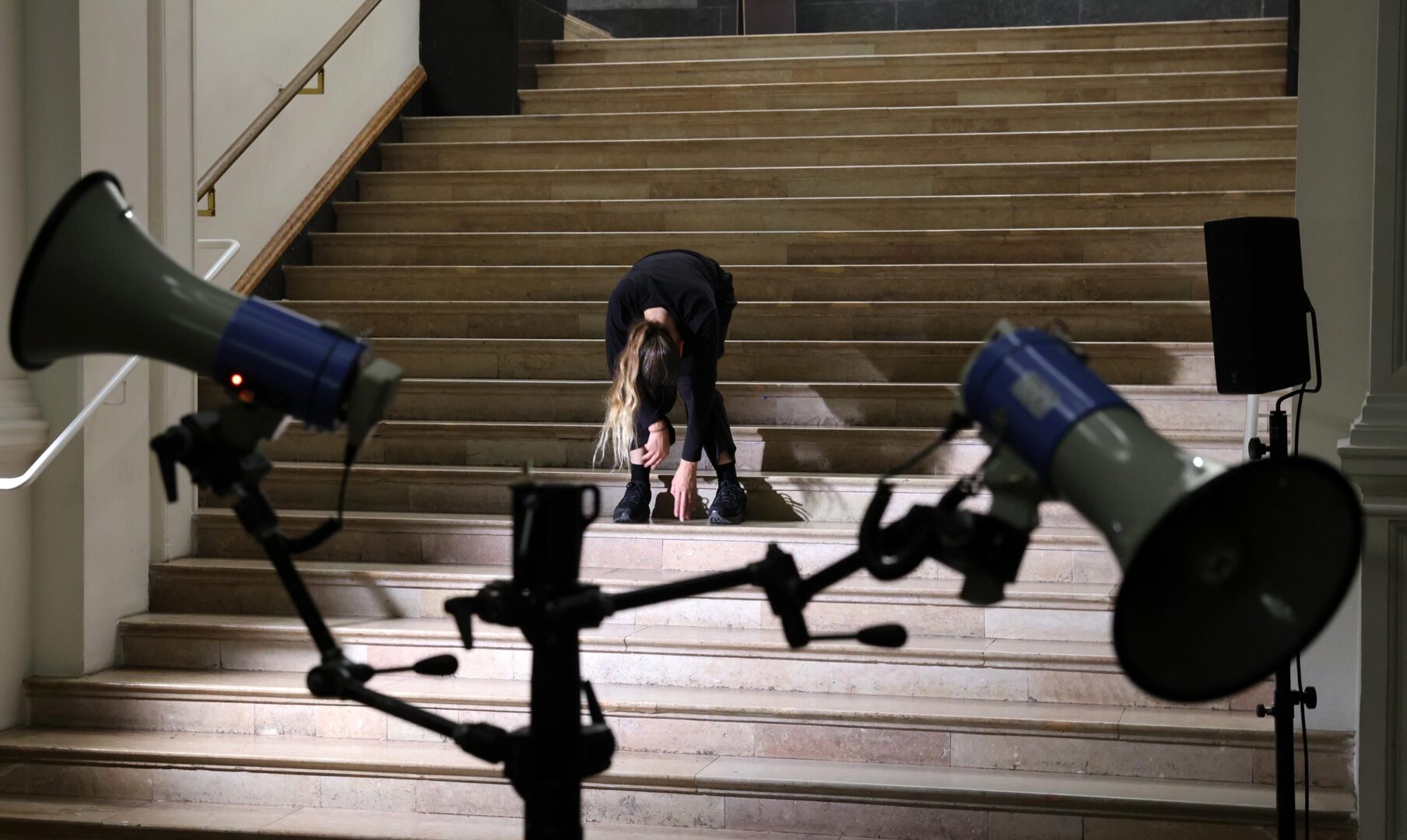
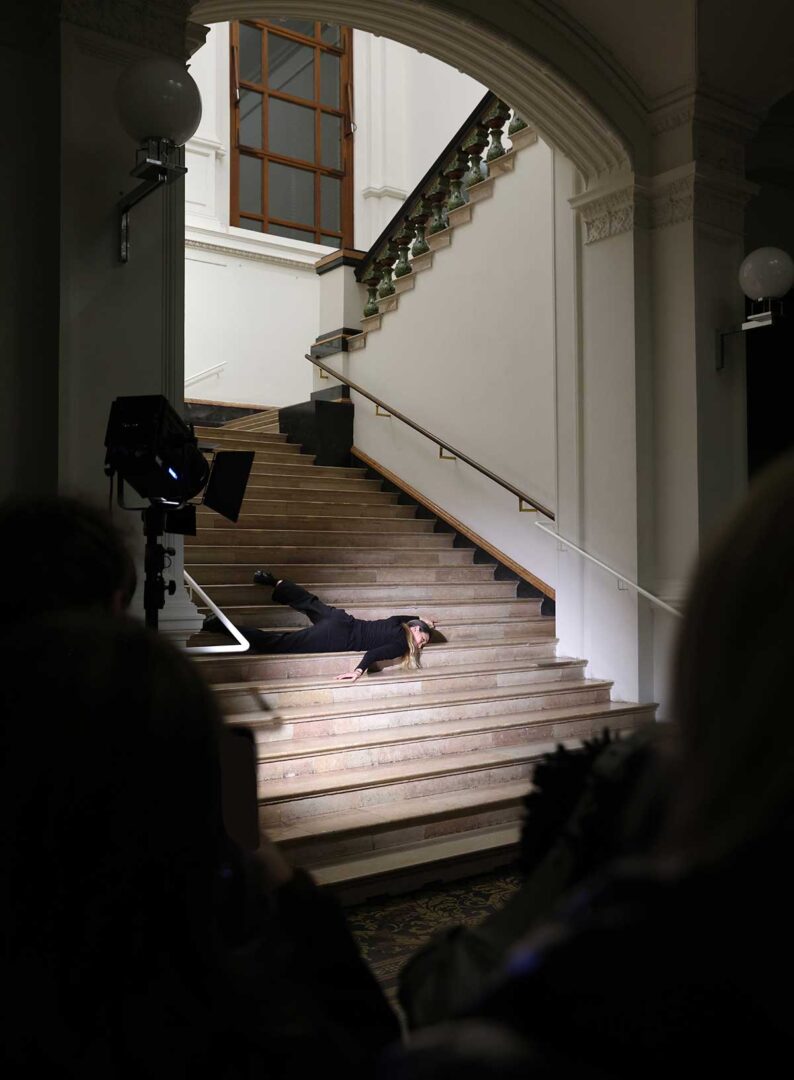
Narisawa frames identity as a form of armor, different performative layers that can express or protect the self. This notion of “armoring” resonates with the renegade psychoanalyst Wilhelm Reich’s notion of character armor—with interesting departures. For Reich, the body encodes its social history in muscle and posture, developing a kind of armoring against external pressure: a hardening that protects but also constrains. Narisawa’s concept of identity as armor operates differently. Pressing the megaphone into her belly, reclining prone on the foyer steps, adopting mannequin-like postures—her gestures signal both vulnerability and authority, the simultaneous presence of identity as fiction and fact. The armor here is not a hardening but a layering: porous, conscious, and deliberately performed for an audience whose projections she is both inviting and examining.
This dynamic becomes most explicit in the work’s voiceover, which arrives about ten minutes into the performance. A voice moves through registers—intimate, robotic, confessional, bureaucratic—assembling a self from the outside in: “I am a complexity of traits, tendencies, and characteristics, woven together through various analyses and texts.” The narration catalogs what we assume is the performer’s personality according to psychometric categories, astrological typologies, and algorithmic assessments, wryly noting that according to a certain cuteness test, she is not cute. This voice both inhabits and parodies the systems through which identity gets measured, sorted, and assigned. “Now, I begin to fictionalize my voice,” it announces—and in doing so, names what the entire performance has been doing from the start.
Near the end of the twenty-minute fragment, the large screen flickers back to life, this time with a brief frenetic montage of personal photographs cycling in Warhol-like silkscreen repetition. And then, the figure of Narisawa on screen—who has been facing away from the camera throughout—slowly turns around and looks directly into the lens. It is a small gesture, but an arresting one. As theorist Sara Ahmed has argued, to be oriented toward another is never a neutral act: it reorganizes the space between bodies, redistributing who is seen and who does the seeing. For the first time, the performer looks back. The text on screen reads: “The person you think I am? The person I think I am? Or the person we really are?” Layer(s) does not resolve this question. It holds it open, returning it to the audience from which it came.