
Text: Michael Dieminger
Every day, millions of people turn to machines to ask what might come next. Climate models anticipate floods before rivers rise. Financial algorithms sense fluctuations before traders do. During pandemics, epidemiological systems sketch the contours of waves before hospitals fill. Dating apps model the likelihood of love between people who have never met. Across the planet, futures are rendered calculable. Screens glow in darkened rooms.
Infrastructures translate questions into forecasts. What appears are probabilities, graphs, projections, forms that promise orientation while withholding their conditions of possibility. The machine speaks but does not explain. In this opacity, consultation emerges. These systems’ outputs organize uncertainty, inviting acts of deciphering. Prediction becomes a site where meaning is not given, but produced: unevenly distributed, shaped by those who define the model, the dataset, and the parameters of legibility.
Computational systems begin to resonate with other ways of engaging the unknown—the oracle. Oracles structure relations in which meaning is already at stake, unfolding through signs and rituals. Computational systems function similarly: questions are posed, outputs taken as signs, patterns interpreted. Between prediction and prophecy, something shifts. Oracular practices unfold within cosmological orders where time, matter, and meaning are inseparable, sustained through ritual and collective authority. Predictive systems operate through probabilistic models and abstraction at scale. They begin to appear in proximity to cosmological orders, yet this appearance remains provisional: oracular practices move within orders that do not align with the terms through which computation renders the world legible. Interpretation is sustained under different conditions: in collective relations in one case, and in the other mediated by models that abstract from the relations they depend on. Computation encounters cosmo-technical orders it can only partially translate, often reducing them to calculable units.
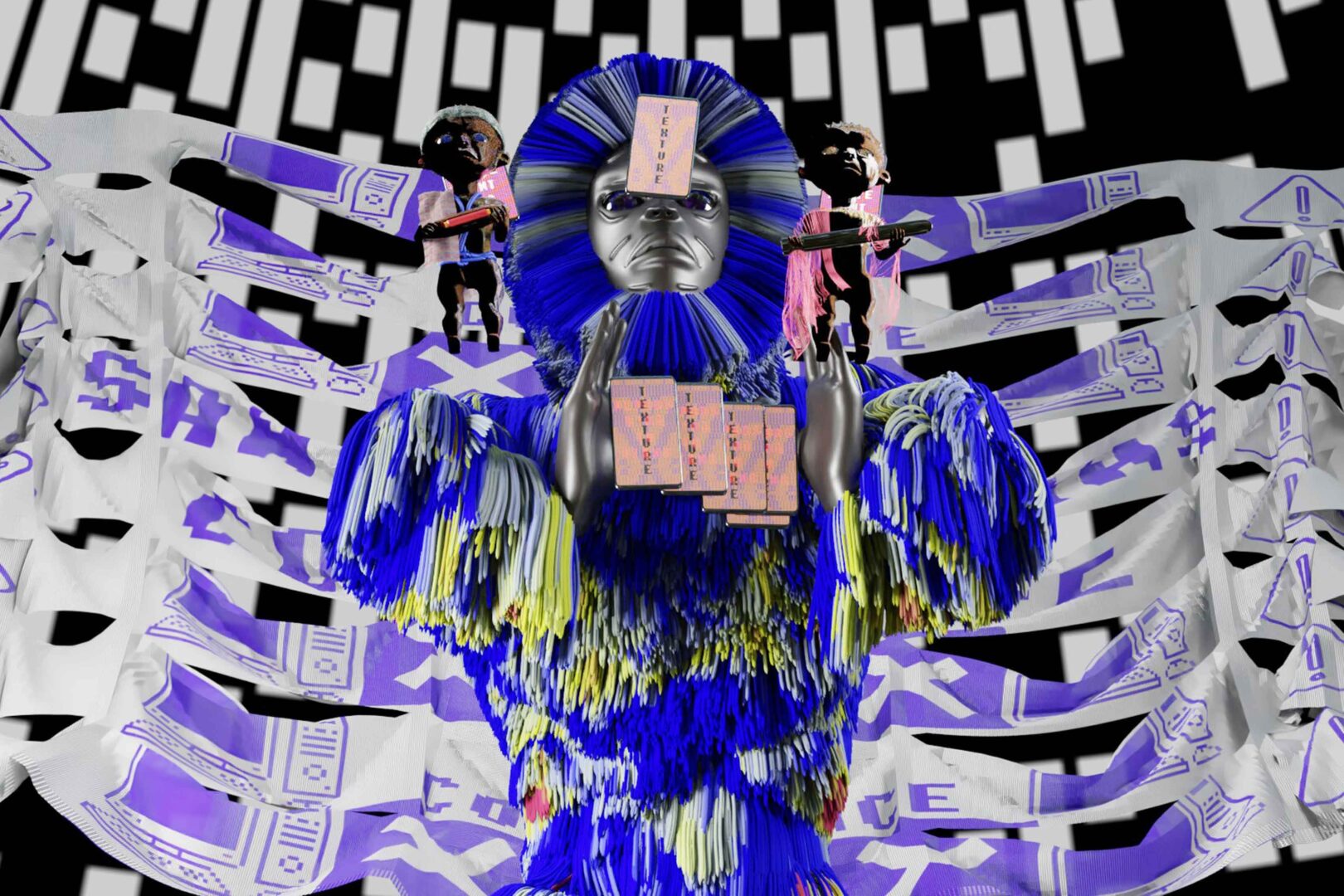
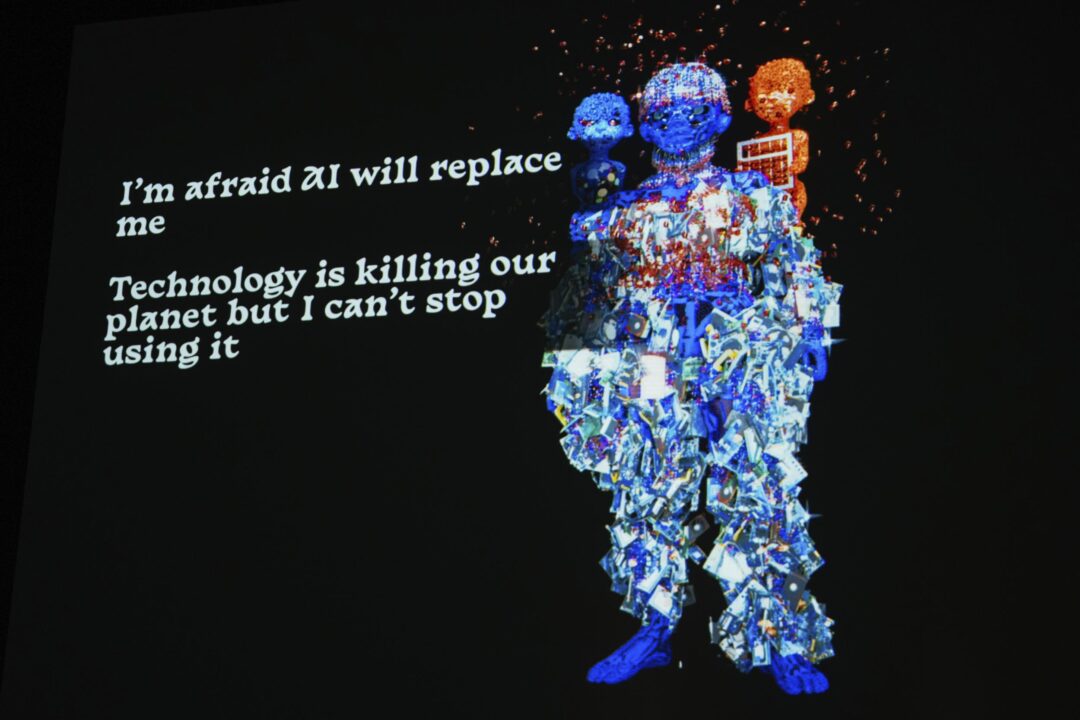
Diane Cescutti’s Gods of Calculation does not illustrate these differences; it stages their irreducibility without resolving them. A shrine-like interface of metal, fiber, textiles, beads, and cables activates fragments on screens: questions, prophecies, invocations. Users can consult five different Gods, each with a distinct mode of address and epistemic position. The Gods appear where computation begins to mimic consultation without sustaining its world. They are not oracles, but traces of an interrupted relation. Their responses differ in tone and structure: some elliptical, others directive, some invoking divinatory authority, others bordering on irony or refusal. Rather than forming a coherent system, they introduce divergent logics of interpretation, each reframing what it means to ask and to receive an answer.
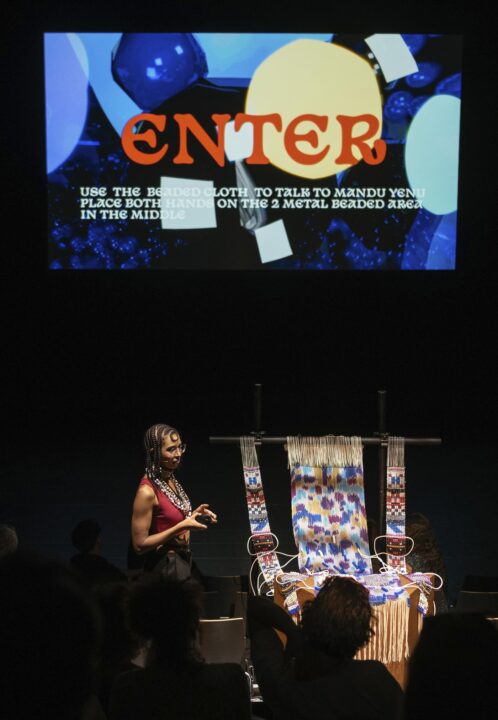
The work draws bodies closer. Visitors lean in. They touch, listen. Calculation appears as something handled, sensed, interpreted. The installation recalls the loom, an early programmable machine in which patterns were encoded before digital computation. Fiber and cable intertwine as material continuity. What we call computation is sedimented in longer histories of encoding and transmission, where matter itself carries forms of knowledge exceeding their reduction into calculable units. Against the abstraction of the cloud, materiality insists: minerals extracted from the earth, infrastructures of energy, and unevenly distributed labor determine who can compute and whose work remains uncounted.
A prophecy appears: “Every time I simulate dark matter, I’m really tracing the ghost of your ancestors’ stolen calculations.” The scale shifts. What appears as universal is revealed as materially and historically situated, embedded in infrastructures of extractivism, labor exploitation, and appropriated knowledge production, where the mining of rare minerals and uneven geographies remain constitutive rather than external. These conditions shape how computation relates to the world, operating across a space where calculation and prophecy come into proximity without becoming equivalent. Yet this relation does not settle: what computation draws into relation, it does not fully inhabit; what it renders legible, it does not understand. The question remains open: “What is the difference between a prophecy and a calculation result, if not a lack of data?”
The project, developed with consultation by mentor Ruth Patir, keeps multiple regimes of interpretation in play. Beneath equations lie genealogies of observation and calculation, circulating across cultures before their appropriation into modern science. What appears as neutral carries the weight of these displacements. From here, prediction extends the present into possible futures, operating through infrastructures that bind data, energy, extraction, and knowledge into systems of calculation. Prophecy unfolds within this movement without mirroring it, presupposing another ordering of the world in which meaning is distributed across relations between time and matter. It does not project forward from the present, but emerges from relations in which past, present, and future are not separable from a world already saturated with significance.
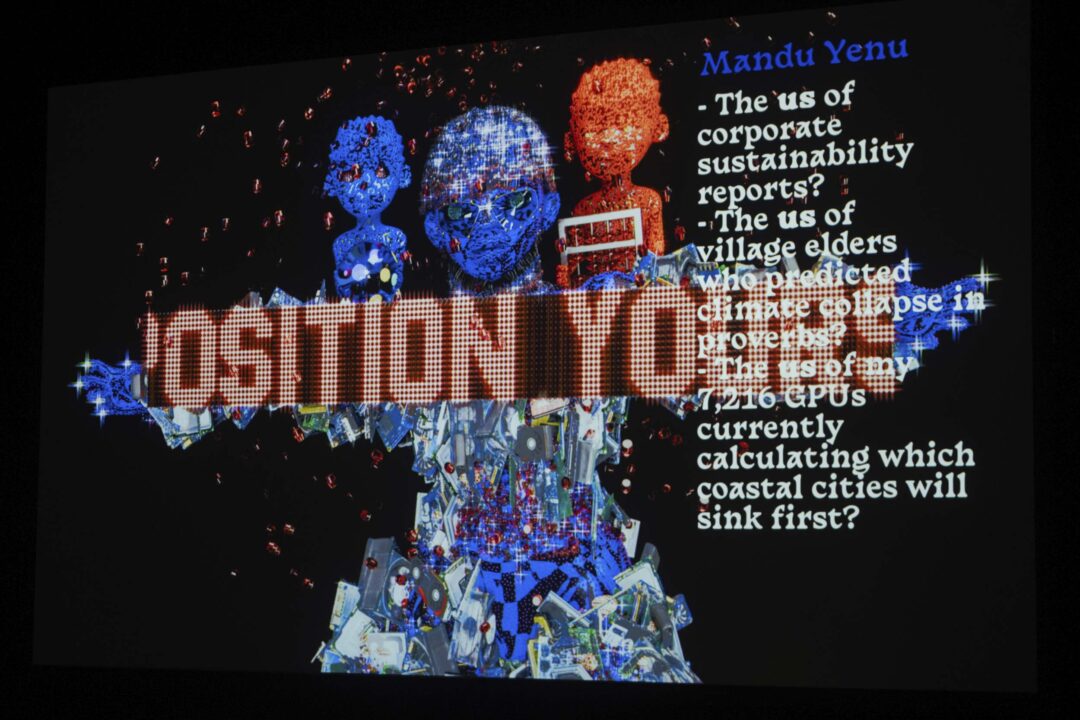
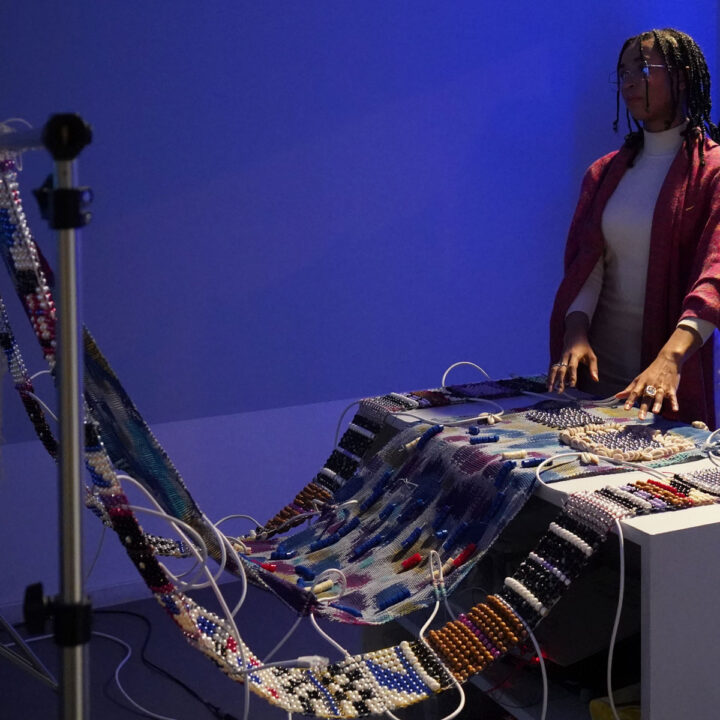
Gods of Calculation does not collapse these differences. It holds them. Visitors consult, entering relations of interpretation without access to the conditions that produce what they interpret. The Gods respond in uneven ways: obscure, humorous, at times abruptly dismissive or even rude. Rather than offering stable answers, they unsettle expectations of clarity and control. What emerges is not equivalence, but encounter. Meaning takes shape in the friction between modes of reading that cannot be reconciled, only inhabited.
Prediction is never purely computational. It depends on infrastructures of labor, materials, extraction, and knowledge. Computation does not replace other ways of knowing. It asserts epistemic authority while remaining unable to account for the interpretations it sets in motion or the histories it continues to displace. The oracle does not answer. We find ourselves consulting.