Text: Renan Laru-an
Photos: Camille Blake

Text: Renan Laru-an
Photos: Camille Blake

My friend used to work for the state’s volcanology agency. She took the job in order to travel across the Philippines. Her task was to install alarm systems in secluded rural and mountainous areas, preparing communities for earthquakes and the trembling ground. In her next posting, she welcomed seismic events like the first rain of May on another island. Outside the realm of geology, she encountered the tremor in children’s bodies, in women’s incessant prayers, in evacuation centers, and in her dreams of anthropomorphizing animals. Once I called her and asked, “What if the earthquake was following you?”
I anticipated the settlement of vibrations from CORIN’s new composition Resonance within my somatic vocabulary. I was informed about the piece’s incorporation of kulintang, a percussive instrument I grew up with in the Philippines’ southern Mindanao region. This event, along with other new-media offerings in the second half of Berlin’s winter, stirred us concert goers to venture outside ourselves, assembled into a temporary tension of communion. I immediately saw the ensemble of gongs when I entered the venue. Unassuming, fixed onto a makeshift table loaded with cables, electronics, and digital music equipment, these nippled bronze structures drew people to intuitively form a circle around them as the performance neared its premiere at CTM. As soon as CORIN began to caress the instrument, her fingers running through the contours of the kulintang, the gongs’ metallic song silenced the crowd.
CORIN’s Resonance created an epicenter of synchronized tenderness. In her experiment with non-Western sound heritage, with mentoring by Sote—who followed her performance with the premiere of Sound Design in Far Sea—she proposed tuning into the cracks of tradition and contemporaneity by soliciting ways of accompanying an environment where sounds could emerge or disintegrate. The performance unfolded amid the lingering waves of internationalization in the art world, as artistic forms circulate across borders threatened by populist motivations. The audience formed a tight circle around the stage, where CORIN conducted the amplification, desynchronization, and synthesis of the tones, melodies, and timbres of elements she has been (un)learning for many years. One by one, visitors pulled themselves away from the center. A swarm disbanded, dispersing like pollen in the air. They searched for the frequencies falling from the 36-channel speaker installed from the ceiling.
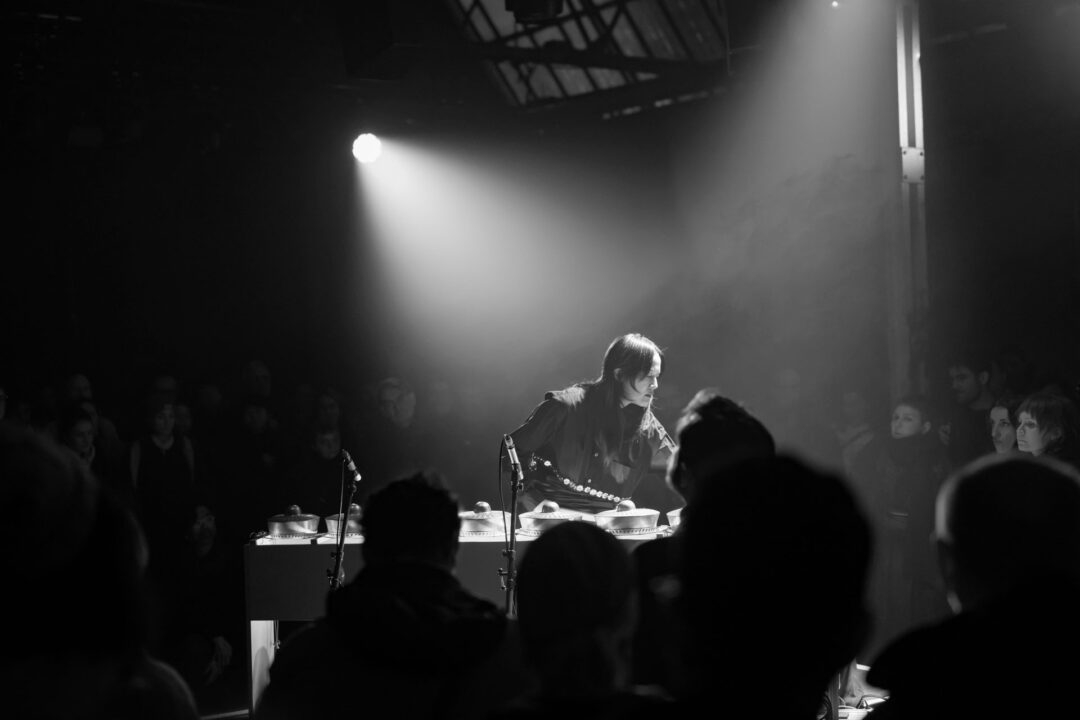
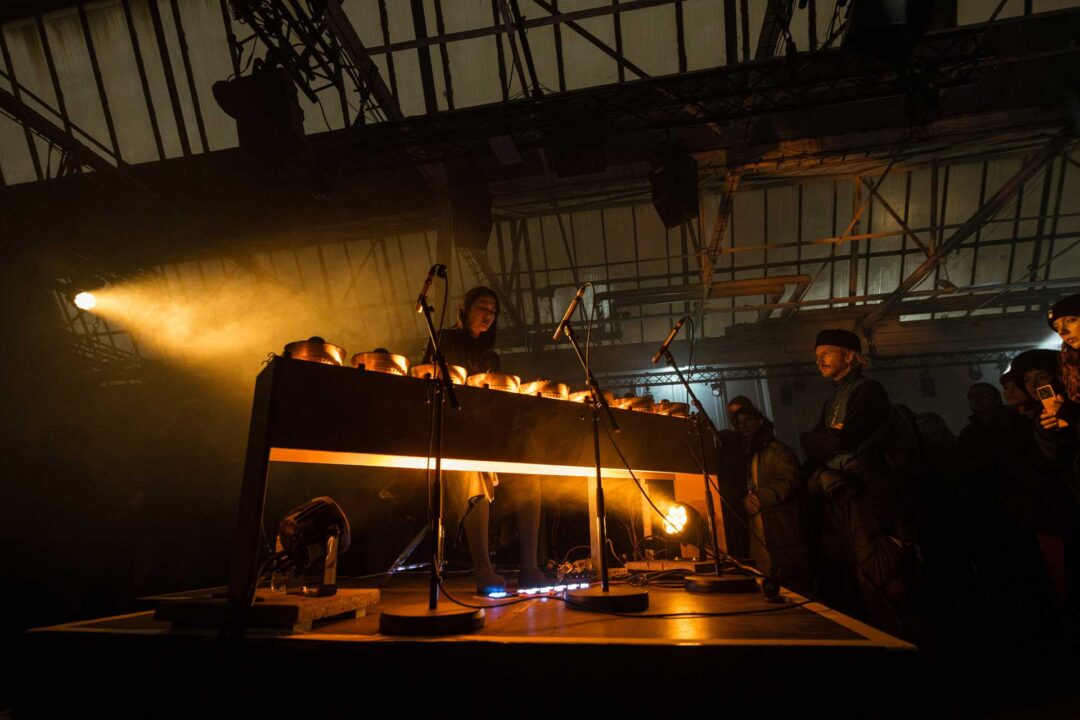
Resonance is one of many improvisations elaborating the relationship between electronic music and indigenous aesthetic fields of sound colors. From avant-garde mediations of ethnomusicology, to the melding of rituals, ceremonies, and daily life into digital spheres and big data, new sounds, like CORIN’s, have become engineering marvels that concretize the haptic in real time. CORIN is invested in manipulating these elements into new forms that she could send back to nature. She could very well be a sculptor, but perhaps an ice carver is a more accurate analogy—someone sensitive to atmospheric conditions and to the qualities and constraints of a liquefying solid.
On my way out of CORIN’s performance, I recalled the late Filipino ethnomusicologist and composer José Maceda who described, in his field notes, the belief among the Maguindanaon people in the power of gong sounds to disrupt earthquakes. I conjured the crossing waves of his 1966 composition Agungan, written for six gong families, with Resonance, which distills an electric atmosphere from non-pitched sounds drawn from the surface of the kulintang. Tingling sensations flowed through my body as if I dipped my toes into a cold, calm lake. Both Maceda and CORIN reorganized my perception of sound-events, reinventing how to assemble within the dynamics of homogeneous gong patterns and the plasticity of synthetic music. I see new colors, and I listen to them intently.
You are currently viewing a placeholder content from Facebook. To access the actual content, click the button below. Please note that doing so will share data with third-party providers.
More InformationYou need to load content from reCAPTCHA to submit the form. Please note that doing so will share data with third-party providers.
More InformationYou are currently viewing a placeholder content from Instagram. To access the actual content, click the button below. Please note that doing so will share data with third-party providers.
More InformationYou are currently viewing a placeholder content from Instagram. To access the actual content, click the button below. Please note that doing so will share data with third-party providers.
More InformationYou are currently viewing a placeholder content from X. To access the actual content, click the button below. Please note that doing so will share data with third-party providers.
More Information